What happened
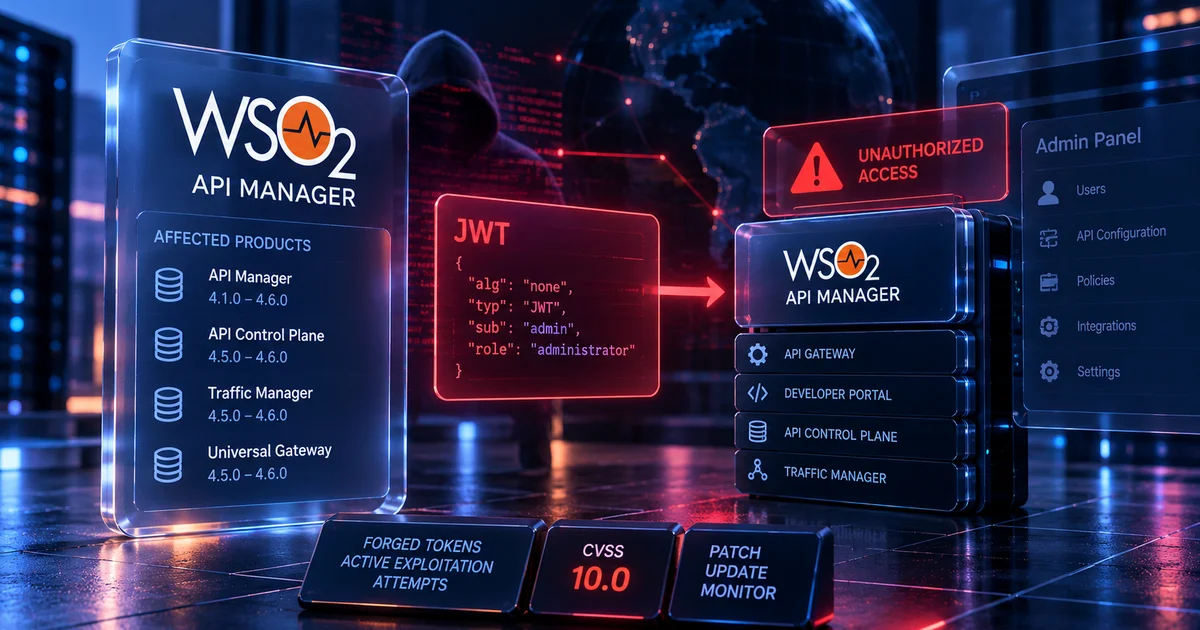
CVE-2026-5430 is a critical authentication bypass vulnerability affecting several WSO2 API management products. WSO2 describes the issue as a JWT authentication weakness in which a token signed with an unsupported algorithm can be incorrectly accepted, allowing an unauthenticated attacker to gain unauthorized access. In the most serious case, this can include administrative account takeover.
WSO2 published advisory WSO2-2026-5328 on May 3, 2026. The vendor rates the vulnerability at CVSS 10.0 for multi-tenant deployments and 9.8 for single-tenant deployments. The difference reflects whether successful exploitation crosses security authority boundaries, but both ratings place the issue firmly in the critical category.
The affected product list includes WSO2 API Manager versions 4.1.0 through 4.6.0, WSO2 API Control Plane 4.5.0 and 4.6.0, WSO2 Traffic Manager 4.5.0 and 4.6.0, and WSO2 Universal Gateway 4.5.0 and 4.6.0. WSO2 credits Hacktron Team with reporting the flaw.
The risk became more urgent in September when watchTowr reported exploitation attempts against internet-facing systems. According to reporting by The Hacker News, watchTowr observed forged JWTs carrying administrator privileges being sent to its honeypot infrastructure. That evidence shows that attackers are actively testing the vulnerability against exposed WSO2 deployments rather than leaving the issue at proof-of-concept stage.
How the JWT bypass works
JSON Web Tokens are commonly used to carry signed authentication and authorization claims between services. A JWT typically contains a header describing the signing algorithm, a payload containing claims, and a cryptographic signature that allows the receiving system to verify that the token came from a trusted issuer and has not been altered.
The security boundary depends on strict verification. The application must accept only approved algorithms, validate the signature using the expected key, and enforce relevant claims such as issuer, audience, expiration, and intended scope. A token should never become trusted simply because its payload looks structurally correct.
CVE-2026-5430 arises because affected WSO2 products can incorrectly accept a JWT signed with an unsupported algorithm. This creates an algorithm-handling failure in the authentication path. An attacker can construct a token containing high-privilege claims and exploit the weak validation logic to have those claims treated as authentic.
A simplified view of the failure is:
Attacker creates forged JWT
        |
        v
JWT declares unsupported signing algorithm
        |
        v
Affected WSO2 authentication path processes token
        |
        v
Signature validation is bypassed or handled incorrectly
        |
        v
Attacker-controlled claims are trusted
        |
        v
Unauthorized access or account takeover
The vulnerability does not mean that JWT itself is broken. The issue is in how the affected WSO2 implementation handles unsupported algorithms. Correct JWT verification requires the server to enforce its own trusted algorithm policy rather than allowing attacker-controlled token metadata to weaken verification.
Active exploitation attempts
The September 2026 activity is significant because it changes the operational priority. A critical vulnerability can remain unexploited for some time, but once public scanning and forged-token attempts begin, internet-facing deployments can receive hostile traffic even when the organization operating them is not individually targeted.
watchTowr reported receiving requests containing forged JWTs with administrator privileges in its honeypot environment. Public reporting does not establish that every observed request resulted in a successful compromise of a real organization, and no specific victim list has been published. The correct conclusion is that exploitation attempts are active and defenders should not treat the issue as theoretical.
API management platforms are attractive targets because they sit in front of business APIs and often have access to administrative functions, credentials, developer portals, API definitions, traffic policies, and integration settings. Administrative compromise of an API management layer can therefore create a broader incident than compromise of a single application endpoint.
Affected products and updates
WSO2 lists the following product families and versions as affected:
WSO2 API Control Plane: 4.5.0, 4.6.0
WSO2 API Manager:       4.1.0, 4.2.0, 4.3.0, 4.4.0, 4.5.0, 4.6.0
WSO2 Traffic Manager:   4.5.0, 4.6.0
WSO2 Universal Gateway: 4.5.0, 4.6.0
For support subscription customers, WSO2 provides specific update levels. API Manager 4.6.0 should be at update level 21 or later, 4.5.0 at 57 or later, 4.4.0 at 72 or later, 4.3.0 at 108 or later, 4.2.0 at 197 or later, and 4.1.0 at 257 or later. The advisory also provides update levels for API Control Plane, Traffic Manager, and Universal Gateway.
Community users are instructed to apply the public fixes provided by WSO2 or migrate to the latest unaffected version. Administrators should use the vendor advisory as the source of truth because a product version number alone may not reveal whether the required WSO2 update level has been installed.
Why it matters for website owners
Although WSO2 API Manager is not a traditional website CMS, many organizations expose developer portals, API gateways, management interfaces, and web applications through the same internet-facing infrastructure. A weakness in the API management layer can affect the authentication boundary protecting those services.
An attacker who gains administrator-level access may be able to inspect or change API definitions, alter policies, create or modify users, access management functions, or interfere with traffic handled by the platform. The exact downstream impact depends on deployment architecture and the privileges granted to the compromised account.
The risk is particularly important for organizations that publish WSO2 interfaces directly to the internet. Automated scanning makes obscure deployments discoverable, and an attacker does not need to know the organization's internal business context before attempting a forged-token request.
Website and API owners should also avoid focusing only on the application code they develop themselves. Identity gateways, API managers, reverse proxies, SSO components, and administrative middleware are part of the externally reachable attack surface and need the same disciplined patching and exposure review as the application behind them.
What to check on your site
- Identify WSO2 products and versions. Inventory API Manager, API Control Plane, Traffic Manager, and Universal Gateway deployments, including staging and disaster-recovery environments.
- Confirm the installed update level. For supported WSO2 products, compare the current update level with the minimum level listed in WSO2-2026-5328.
- Review public exposure. Determine which management, publisher, developer, and gateway interfaces are reachable from the internet and whether that exposure is necessary.
- Review authentication logs. Look for unexpected administrator sessions, unusual JWT authentication failures, unfamiliar source addresses, and access patterns that do not match normal administrative activity.
- Check privileged accounts. Review newly created users, role changes, administrator assignments, and configuration changes made since the vulnerability became public.
- Review API configuration changes. Investigate unexplained modifications to APIs, policies, subscriptions, endpoints, keys, and traffic-management settings.
- Check secrets after suspected compromise. If unauthorized administrative access is confirmed, rotate credentials, tokens, keys, and integration secrets that could have been viewed or changed.
- Preserve logs before cleanup. If compromise is suspected, retain WSO2, reverse-proxy, identity, and infrastructure logs for incident investigation.
JWT validation lessons
CVE-2026-5430 illustrates a recurring JWT security lesson: the server must decide which algorithms and keys are trusted. The algorithm field inside a JWT is attacker-controlled data until the token has been successfully verified. Applications should not allow that field to expand or weaken the server's verification policy.
Defensive JWT processing should enforce a small allowlist of acceptable algorithms, bind each issuer to the expected verification key material, validate issuer and audience claims, reject expired tokens, and reject tokens that use unexpected or unsupported algorithms. Administrative APIs should also apply authorization checks after authentication rather than assuming possession of a token automatically grants broad access.
Developers can use Vulnify's JWT Token Decoder to inspect token headers and payload claims during authorized testing. The tool is useful for understanding what a token declares, but decoding is not the same as cryptographic verification. A decoded JWT should never be considered authentic merely because its contents are readable.
Using Vulnify for follow-up review
Vulnify can support the public-surface side of an investigation without claiming to prove whether CVE-2026-5430 is patched internally. The TLS Deep Analysis tool can help review the externally visible TLS configuration protecting WSO2 web interfaces, while the JWT Token Decoder can help developers inspect token structure during controlled validation work.
These checks complement, rather than replace, WSO2's own version and update-level verification. A public TLS scan cannot determine whether the vulnerable JWT authentication code has been fixed, and a token decoder cannot verify the authenticity of a production token. Direct administrative access to the WSO2 deployment is required to confirm remediation.
Organizations with several internet-facing systems may also benefit from maintaining an inventory of API gateways, developer portals, identity endpoints, and administrative consoles. Exposure that is no longer required should be removed or restricted, reducing the number of systems available to automated scanning.
Recommended response
Organizations running an affected WSO2 release should treat the vendor update as the primary remediation. Apply the specified WSO2 update level or the public fix appropriate to the deployment, then confirm that the running services have actually loaded the corrected code.
Because exploitation attempts have been observed, high-value deployments should also receive retrospective review. Check privileged logins and configuration changes from before patching, especially if administrative interfaces were internet reachable. If suspicious activity is found, widen the investigation to connected systems and credentials rather than limiting review to the WSO2 host.
Where immediate patching is not possible, reduce exposure of management interfaces and apply network-level access restrictions consistent with operational requirements. This is temporary risk reduction, not a replacement for the vendor fix.
Related reading
Conclusion
CVE-2026-5430 is a critical authentication flaw in multiple WSO2 API management products. The vulnerability allows unsupported JWT signing algorithms to be handled incorrectly, creating a path for attacker-controlled claims to be accepted and potentially leading to administrative account takeover.
The risk is heightened by active exploitation attempts observed in September 2026. Administrators should verify both the product version and the WSO2 update level, apply the vendor fix, review exposed management interfaces, and inspect privileged activity for signs of earlier abuse.
The broader lesson is that JWT security depends on verification, not decoding. Systems must enforce their own trusted algorithms, keys, and claims, and internet-facing API management infrastructure should be inventoried and patched with the same urgency as the applications it protects.