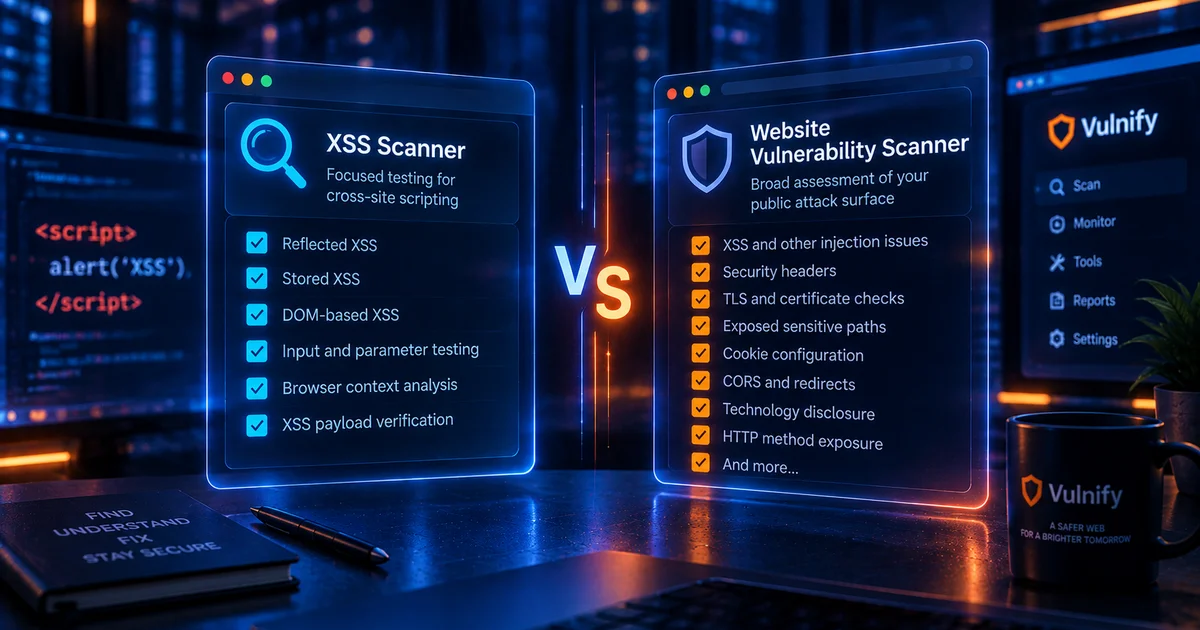
An XSS scanner and a website vulnerability scanner are related, but they answer different questions. An XSS-focused tool concentrates on cross-site scripting inputs, reflections, browser contexts, and execution paths. A broader website vulnerability scanner looks for XSS alongside other public-surface weaknesses such as injection indicators, exposed paths, insecure headers, TLS issues, cookie configuration, redirects, CORS, and technology disclosure.
Choosing between them is less about which tool is better and more about scope. If you already have a confirmed XSS symptom, a focused workflow can be faster. If you are trying to understand the security posture of a website after deployment, a broader scan is usually more useful.
In practice, the strongest workflow often uses both. Broad scanning discovers where to investigate. Focused XSS testing explains the exact rendering context. Broader verification then checks whether the deployment introduced other weaknesses while fixing the original bug.
What an XSS scanner does
A dedicated XSS scanner concentrates on locations where attacker-controlled data can reach browser rendering or script execution. Depending on the tool, it may probe query parameters, forms, headers, fragments, DOM behavior, API-driven inputs, or stored application fields.
- Reflected XSS candidates.
- Stored XSS candidates where the workflow allows persistence and later rendering.
- DOM-based XSS behavior.
- Context-specific reflections.
- Unsafe browser sinks or client-side data flows.
- Parameters likely to influence rendering.
The narrower scope can be valuable when a developer is debugging one finding. The scanner can spend more attention on browser context and payload behavior instead of dividing effort across many vulnerability classes.
What a website vulnerability scanner does
A website vulnerability scanner typically tests a wider public attack surface. XSS is one vulnerability class among many. The broader goal is to identify exposed weaknesses an internet-facing site presents.
- XSS and other injection indicators.
- Security-header weaknesses.
- TLS and certificate issues.
- Exposed sensitive paths.
- Cookie security problems.
- CORS configuration.
- Redirect behavior.
- Technology disclosure and visible components.
- HTTP method exposure.
- Other web configuration issues supported by the scanner.
Why scope matters
A developer fixing one XSS bug does not necessarily need a complete internet-facing assessment before every local code change. Conversely, a site owner launching a production environment should not run only an XSS tool and assume the rest of the public attack surface is covered.
The decision should start with the question being asked. "Can this search parameter execute script?" is a focused XSS question. "What security weaknesses did this release expose?" is a broader website-security question.
Discovery and validation are different jobs
Broad scanning is valuable for discovery because it can surface several classes of weakness in one pass. A focused XSS workflow is valuable for validation because it can concentrate on the source, sink, browser context, role boundary, and exact proof.
Teams often make mistakes when they expect a discovery scan to replace manual validation or expect a specialist XSS tool to provide complete website coverage. Keeping the jobs separate makes the process easier to reason about.
Hypothetical scenario: ecommerce release
An ecommerce team deploys a redesigned product-review feature. A broad scan identifies a possible XSS issue in review previews, a missing security header, an exposed backup file, and a cookie configuration weakness.
The team then uses a focused XSS workflow on the review feature. It determines that the public preview safely escapes the review text, but the moderation dashboard renders the same stored review through a raw HTML component. The focused investigation confirms a real stored XSS path that the broad scan could only partially observe.
After remediation, the team retests the specific review workflow and then runs the broader website scan again. The broad verification catches a separate deployment regression where a staging archive was accidentally left publicly accessible.
The two tools answered different questions, and both were useful.
Hypothetical scenario: a small business website
A small business has a marketing website with a contact form, CMS, and a few third-party scripts. The owner does not have a security team and mainly wants to know whether the public site exposes obvious weaknesses.
Starting with a broader website vulnerability scan makes more sense than beginning with a specialist XSS tool. If the scan finds an XSS candidate, the developer can then use focused testing to validate the exact field and fix it.
Decision guide
Use an XSS-focused workflow when:
- You are validating a specific XSS finding
- You are reviewing a raw HTML rendering path
- You need context-specific reproduction
- You are retesting an XSS fix
- You are tracing browser-side source-to-sink behavior

Use a broader website vulnerability scanner when:
- You are assessing a site after deployment
- You do not know which vulnerability classes exist
- You want public-surface coverage beyond XSS
- You need a wider remediation backlog
- You want to catch configuration regressions
Limitations of XSS-only testing
An XSS-only test can leave unrelated but important risks completely unexamined. A site might have excellent output encoding but still expose backups, permit weak cross-origin behavior, serve insecure cookies, reveal sensitive technology information, use weak headers, or expose dangerous server configuration.
This matters operationally because attackers do not care which security category your team is currently testing. They look for any useful weakness.
Limitations of broad scanning
A broad scanner must allocate effort across many vulnerability classes. It may identify an XSS candidate without exploring every stored workflow, privilege boundary, browser state, framework-specific escape hatch, or client-side event.
Deep validation still matters. A scanner might show that a value reflects into a page, while a human review determines whether the context is actually executable and which component is responsible.
Authentication changes the comparison
If the valuable parts of the application are behind login, scan coverage depends heavily on whether the tool can reach authenticated routes. A public-only scanner can still assess the anonymous surface, but it cannot automatically prove the security of internal dashboards it never sees.
For applications with multiple user roles, plan testing around the roles. Stored XSS may involve a standard user creating data and an administrator later viewing it. That workflow requires more than anonymous crawling.
What good XSS evidence looks like
- Affected URL or workflow.
- Source of attacker-controlled data.
- Exact rendering context or sink.
- Authentication and role requirements.
- Minimal reproduction steps.
- Observed browser behavior.
- Recommended context-appropriate remediation.
- Retest result after the fix.
Focused XSS tools and manual validation should help enrich a broad scanner finding with this context.
How Vulnify separates these workflows
Vulnify provides different levels of public-surface testing. The XSS Payload List supports controlled manual XSS testing. The Website Vulnerability Scanner offers a focused public vulnerability check, while the Website Security Scanner supports broader assessment.
The important point is that these pages are complementary. A payload reference is not a complete scanner, and a broad scanner is not a substitute for detailed browser-context analysis when a finding needs to be validated.
How to use both effectively
Step 1: Discover
Run a broad public assessment to identify likely weaknesses and affected areas. Record the baseline before making changes.
Step 2: Prioritize
Review severity, exposure, exploitability, and business context. XSS affecting an administrator may deserve different priority from a safely encoded public reflection.
Step 3: Validate
Use focused XSS testing to identify the source, sink, context, victim role, and minimum proof.
Step 4: Remediate
Fix the rendering or trust-boundary problem in code. Avoid relying only on blacklists, WAF rules, or one blocked payload.
Step 5: Retest
Verify the exact XSS path and then run broader scanning again to check the deployment for related regressions or other exposed weaknesses.
When code review is still needed
Neither scanner type can replace code review for every application. Code review can reveal raw HTML rendering, unsafe trust-bypass functions, dangerous URL construction, or privilege assumptions that are difficult to trigger automatically.
For high-value applications, use external scanning to show what is reachable from the outside and code review to understand what unsafe patterns exist internally.
Choosing the right tool: quick checklist
- Are you investigating one XSS symptom or the whole website?
- Do you need authenticated coverage?
- Does the application rely heavily on client-side JavaScript?
- Do you need detailed browser-context evidence?
- Do you also need configuration, TLS, cookie, and exposure checks?
- Will developers need a reproducible report?
- Are you testing before release, after release, or after remediation?
Frequently asked questions
Is XSS scanning part of vulnerability scanning?
Usually, yes. XSS is one vulnerability class commonly included within broader web vulnerability assessment.
Should I run focused XSS testing after a clean website scan?
For high-value applications or complex browser workflows, targeted XSS testing can add confidence even when a broad scan reports no issue.
Can broad scanning replace code review?
No. External testing shows what is observable and reachable from the tested surface. Code review can reveal unsafe patterns and trust decisions that are difficult to trigger automatically.
Which should I run first?
If you do not already know the problem, start broad. If you have a specific XSS finding or suspicious renderer, start focused, then run a broader verification after remediation.
Conclusion
An XSS scanner goes deep on one class of browser injection. A website vulnerability scanner goes wider across the public attack surface. Strong security programs use the distinction deliberately: broad discovery, focused validation, precise remediation, targeted retesting, and then broad verification. Vulnify's focused tools and broader scanners are most useful when treated as complementary parts of that workflow.