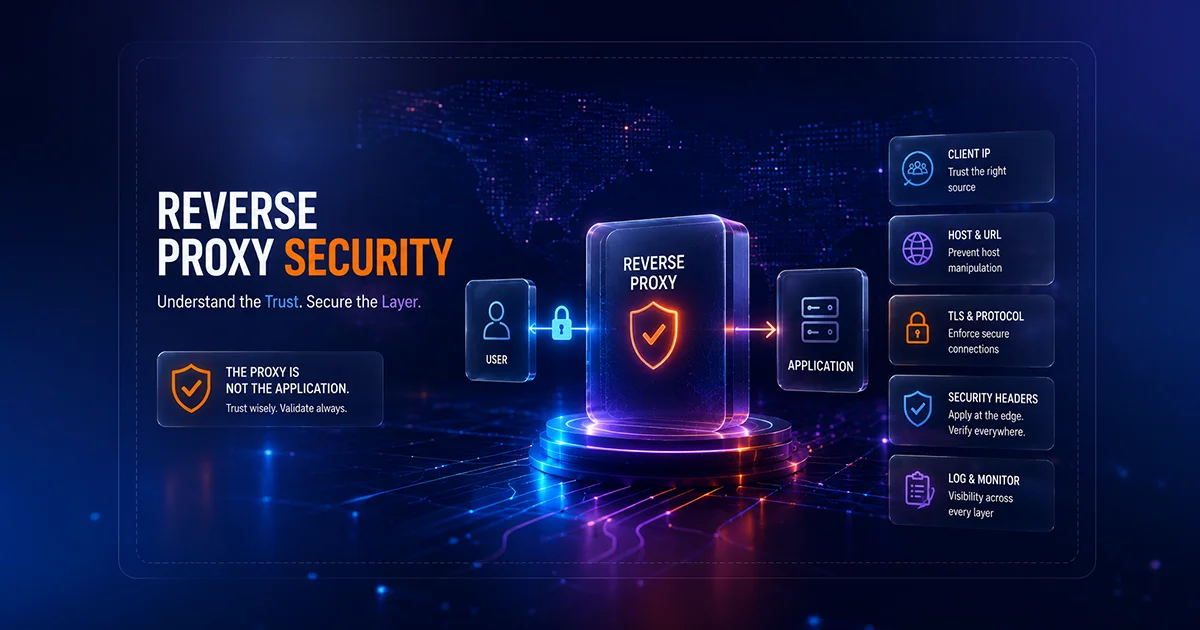
Reverse proxies are everywhere. A public request may reach Cloudflare, Akamai, Fastly, a cloud load balancer, Nginx, an ingress controller, an API gateway, or several of them before the application sees it. These systems improve availability, performance, routing, and security, but they also change one of the most important assumptions in a web application: the request the application receives is no longer necessarily the request the client sent directly.
The proxy may replace the source IP, terminate TLS, rewrite the host, normalize paths, add forwarding headers, remove security headers, cache responses, or route traffic to a different upstream. If the application blindly trusts transformed values, an operational convenience can become an application-security weakness.
Reverse proxy security is therefore about trust boundaries. Teams need to know which intermediary is trusted to assert client information, which headers can be accepted from the public internet, where TLS is actually enforced, how hostnames are validated, and which layer owns browser security controls. The safest architecture makes those decisions explicit instead of inheriting defaults.
What a reverse proxy changes
When a browser connects directly to an application server, the application can observe the network peer, requested host, scheme, path, and headers with relatively little ambiguity. Behind a proxy, some of that information is lost or transformed.
RFC 7239 defines the standardized Forwarded HTTP header for proxy scenarios. It can communicate information such as the original client-facing address, host information, and whether HTTP or HTTPS was used. Many real deployments also use common non-standard headers such as X-Forwarded-For, X-Forwarded-Host, X-Forwarded-Proto, and X-Real-IP.
These values can be useful, but they are not automatically trustworthy. A normal client can send an X-Forwarded-For header too. If the trusted edge does not sanitize incoming copies and establish a known value, the application may mistake attacker-controlled data for information asserted by infrastructure.
Define the trusted proxy boundary
The core rule is simple: trust forwarding information only when it came through infrastructure you control or explicitly trust, and configure that infrastructure so public values cannot silently masquerade as trusted metadata.
- Do not enable broad framework trust-proxy behavior without understanding the expected proxy hops.
- Do not use arbitrary X-Forwarded-For data as privileged IP identity.
- Do not build security-sensitive links from unrestricted forwarded host values.
- Do not assume X-Forwarded-Proto proves the public scheme unless the trusted edge established it.
- Strip, replace, or normalize client-supplied forwarding metadata according to the architecture.
The exact syntax differs across Nginx, cloud load balancers, Kubernetes ingress, application frameworks, and CDN providers. The principle does not: the application should know which systems are authorized to make assertions about the original request.
Client IP is useful context, not strong identity
Applications frequently use source IP for logging, fraud controls, throttling, analytics, and sometimes administrative allowlists. Behind a reverse proxy, the direct network peer is normally the proxy, so the original address has to be carried separately.
This is where unsafe trust can create bypasses. If an application simply trusts whichever value the client puts first in X-Forwarded-For, an attacker may be able to present a trusted-looking address. Safe extraction depends on the real proxy chain. Some systems walk the chain from a known trusted side. Other platforms supply a provider-specific value that the edge overwrites.
Even correctly identified client IP should normally remain a defense-in-depth signal. NAT, corporate egress, mobile networks, proxies, and privacy services mean multiple users can share an address. Sensitive administration should still rely on proper authentication and authorization.
Host and forwarded host need strict handling
The Host header tells a web server which hostname the client wants. Virtual hosts, proxies, caches, and applications can all use it. Applications sometimes also use Host when constructing absolute redirects, password-reset URLs, canonical links, or callbacks.
OWASP's Web Security Testing Guide describes how unsafe Host handling can contribute to redirects to attacker-controlled domains, password-reset manipulation, web-cache poisoning, and access to unintended virtual hosts. Proxy environments add more complexity because an application may also inspect X-Forwarded-Host or forwarded host metadata.
Do not treat arbitrary host-like headers as trusted configuration. Prefer a configured canonical base URL for security-sensitive links. Where dynamic host behavior is necessary, allowlist the hostnames the application is expected to serve and reject unexpected values before they influence redirects, reset links, or cacheable content.
TLS termination creates another trust boundary
Many websites terminate public TLS at a CDN or load balancer and forward traffic to an application on a separate connection. The origin application may therefore see internal HTTP even though the visitor used HTTPS externally.
This architecture is normal, but the application needs a reliable way to understand the original public scheme. Frameworks often rely on trusted-proxy configuration and a forwarded-protocol field. If the trust relationship is wrong, several problems can appear:
- The application may generate HTTP absolute links for an HTTPS visitor.
- Secure-cookie behavior may become inconsistent.
- HTTPS-only logic can depend on a spoofable forwarded value.
- The application and edge can create redirect loops because they disagree about the current scheme.
Teams should also decide deliberately whether traffic between the edge and origin is encrypted. Public HTTPS at the CDN does not automatically prove every internal hop is protected.
HSTS must reflect the public HTTPS architecture
Strict-Transport-Security tells browsers to prefer HTTPS for a host after they receive the policy over HTTPS. In proxy environments, HSTS is often added at the edge because the edge owns the public TLS connection. That can be a sensible pattern, but it should have clear ownership.
If the application also emits HSTS, verify that the edge does not remove, duplicate, or unexpectedly replace it. If only the edge sets it, test different routes and error responses. Before using includeSubDomains or preload-related settings, verify the affected subdomains are prepared to operate exclusively over HTTPS.
Use Vulnify's HSTS Checker and Security Headers Analyzer against the public hostname. The result users receive after every proxy has processed the response is the result that matters.
Decide which layer owns security headers
Headers are a common source of edge misconfiguration because several systems can add the same field. A framework may set CSP. Nginx may add X-Content-Type-Options. The CDN may apply HSTS. A CMS security plugin may add X-Frame-Options. The final response can become duplicated or contradictory.
Broad defaults can be applied at the edge when every route shares them, while route-specific controls often belong closer to the application. CSP in particular can differ between an embedded page, a checkout, and a static marketing page. Whatever model is chosen, document ownership and verify the public response after changes.
Caching can preserve security mistakes
CDNs and reverse proxies cache responses to reduce load and latency. Cache behavior becomes security-sensitive when personalized content is cached publicly, when the cache key ignores inputs that materially change the response, or when attacker-controlled host information influences cached output.
OWASP's Host Header Injection guidance describes cache poisoning as one possible consequence in vulnerable environments. The broader lesson is that cache configuration should be reviewed like application configuration. Do not publicly cache authenticated content unless the architecture is explicitly designed for it. Make sure the cache varies on the inputs that legitimately produce different public representations.
After changing cache rules, verify that stale responses have expired or been purged where necessary. A corrected origin does not help immediately if the edge continues serving the insecure cached version.
A CDN does not automatically make the origin private
Putting a website behind a CDN or WAF changes the preferred public request path, but it does not automatically guarantee that the origin is unreachable directly. Old DNS records, alternate hostnames, historical infrastructure data, or other services can reveal an origin address.
Whether direct access is acceptable depends on the architecture. If the CDN provides WAF rules, rate limiting, authentication, or other security controls that the origin does not independently enforce, direct origin reachability can weaken the intended boundary. Where appropriate, restrict origin access to trusted edge networks or use provider-supported authenticated origin mechanisms.
Vulnify's WAF / CDN Detector can identify common public edge-provider signals, while the Website Technology Fingerprint can help review exposed stack information. These public checks do not prove that an origin is private, so network and origin-access review remains an infrastructure task.
Redirects expose proxy disagreements quickly
Redirect loops and incorrect schemes commonly appear after moving an application behind a proxy. The edge redirects HTTP to HTTPS, but the application sees the internal request as HTTP and redirects again. A forwarded-host mistake sends a user to an unintended domain. A stale canonical rule sends visitors through an old hostname.
Run Vulnify's Redirect Chain Checker after edge changes. Clean redirect behavior is also a useful indicator that scheme and host information is being interpreted consistently throughout the stack.
Logging also depends on correct proxy trust
Bad forwarding configuration can damage incident response as well as prevention. If application logs contain only the load balancer address, useful client context is lost. If the application blindly trusts public forwarding headers, attackers can inject misleading IP data into logs.
Keep edge logs where possible and document how client information moves through the proxy chain. Security analysts should be able to distinguish the direct network peer from a client address asserted by a trusted intermediary.
A practical reverse proxy security review
1. Map the public request path from DNS to the application.
2. Identify every trusted CDN, proxy, gateway, ingress, and load balancer.
3. Define which component sanitizes forwarding headers.
4. Configure the application to trust only the intended proxy boundary.
5. Validate Host and forwarded-host values against expected domains.
6. Confirm how the original HTTPS scheme is communicated.
7. Verify public HSTS, CSP, framing, and other security headers.
8. Review cache behavior for authenticated and host-dependent content.
9. Confirm whether direct origin access is intended and controlled.
10. Test redirects, error pages, and representative routes.
11. Review logs for spoofable forwarding information.
12. Re-test after CDN, proxy, framework, or ingress changes.
How Vulnify fits into reverse proxy review
Reverse proxy security requires both infrastructure review and public verification. Vulnify can support the externally observable side. Use the WAF / CDN Detector for edge fingerprints, the Security Headers Analyzer and HSTS Checker for browser-facing policy, and the Redirect Chain Checker for host and scheme transitions.
A broader Website Security Scanner assessment can identify public-surface issues that appear after proxy changes, including TLS, headers, redirects, cookies, CORS, exposed paths, technology disclosure, and application vulnerabilities. It does not replace inspection of private routing, origin firewall rules, or internal proxy trust configuration.
Reverse proxy security checklist
- Document the full trusted proxy chain.
- Sanitize client-supplied forwarding metadata at the trusted edge.
- Trust only known proxy hops in the application.
- Do not use spoofable IP data as the only authorization control.
- Allowlist expected hostnames for security-sensitive URL generation.
- Verify scheme handling after TLS termination.
- Assign clear ownership for security headers.
- Review cache rules for private and personalized responses.
- Restrict direct origin access when edge controls depend on it.
- Verify redirects after CDN and hostname changes.
- Preserve trustworthy logging across the proxy chain.
- Re-test the public origin after infrastructure changes.
Conclusion
Reverse proxies solve real availability and security problems, but they change the application's view of the request. Client IP, scheme, host, TLS state, caching, and response headers become information passed across trust boundaries. If those boundaries are vague, the application may trust data that actually came from an attacker.
Make the proxy chain explicit. Sanitize untrusted forwarding data, validate hosts, configure trusted proxies narrowly, verify TLS and security headers at the public edge, and control direct origin access according to the architecture. Then test what users actually receive. That approach keeps reverse proxies as a security layer rather than allowing them to become an invisible source of trust confusion.